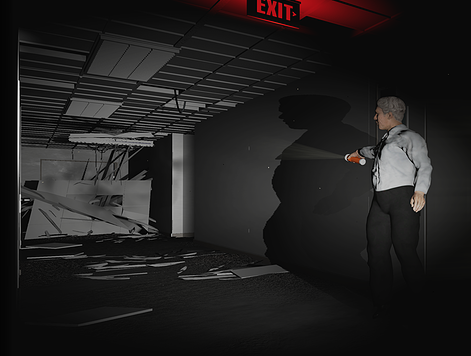
A new narrative-driven VR experience for the Oculus Rift allows users to embody an office worker in the North Tower of New York’s World Trade Center during the tragic events of Sept. 11, 2001.
But a lot of negativity surrounds the big question: Who would want to live or relive 9/11?
Students at a French University, Ecole Nationale des Jeux et Medias Interactifs et Numeriques, developed the project, dubbing it [08:46], which was the time when the first plane hit the World Trade Center.
(Related: Google Glass is being used to help treat autism)
The team researched and looked through documentation from the event in order to recreate what happened in the tower, and they also worked with two actors for motion capture and voice acting. The project was completed in about two and a half months by a six-man team. The simulator was first released on Sept. 11 of this year.
The project is not a game, and the team’s goal is to portray the historical event to remind people of the victims that were lost on a “Tuesday that was like any other day,” according to Anthony Krafft, creative director for [08:46].
“Many bad things happen in the world, and these [victims] are close to us on a social point of view,” said Pierre-Yves Revellin, producer of [08:46]. “The victims of 9/11, they were office workers just like us, that spent most of their lives in front of a computer, and you can’t [comprehend] what will happen tomorrow.”
Last week, the project received attention, including some expected backlash from those who were old enough to remember the events of that day.
“The backlash is mostly that we are doing an experience of 9/11, and most people are confusing this with a game,” said Revellin. “Many are thinking that this is a game to have fun with, but it is not.”
However, for some who personally witnessed the collapse of the Twin Towers on 9/11, the experience still is too raw and traumatic. Simon Doubleday, professor and chair of the Department of History at Hofstra University, doesn’t see the benefits of the project that “counterbalances its insensitivity,” given that he is one that witnessed the event and had students that lost family members that day.
“I have always resented the way in which the story of the terror attacks have been co-opted by people with vested military, political or financial interests,” he said.
From an educational perspective, historical reconstructions, whether they be in virtual reality or on The History Channel, always run the risk “of hijacking human suffering for the sake of entertainment, vicarious curiosity or commercial profit,” according to Doubleday. “There are urgent questions we need to ask about our ethical responsibilities to the dead, and to the families and friends of the dead.”
But this is one of the goals of the [08:46] team: to use the medium of virtual reality to “make people think about the world,” and to use it to educate those who otherwise had experienced or learned about the historical event through the screen of a television.
“History is not just statistics or pictures,” said Krafft. “Even in France, we all remember. We were pretty young when it happened, and it has been a historical event in our lifetime.”
Krafft said that they did get “lots of positive feedback,” even from someone who claimed to be a survivor of the 9/11 terror attacks.
The system requirements for this app include Oculus Rift DK2, an Xbox gamepad, and a GTX 970 graphics card or greater.