
As enterprises scramble to integrate autonomous AI agents into their core business processes, a new economic reality is setting in. While frontier models accessible by cloud APIs offer the fastest path to innovation, they are simultaneously creating what experts call the Agentic Paradox: where the cost of success threatens to bankrupt the very innovation it … continue reading

PITTSBURGH, Pa. — Lovelace has emerged from stealth to introduce Elemental, an enterprise context engine builder designed to meet the demands of speed, scale, and accuracy in high-stakes environments – dramatically increasing the investigative power of AI agents by 1000x on complex queries, making the company the only provider of enterprise-scale context engines for mission-critical applications. … continue reading

NEWARK, N.J. — Runpod, the AI developer cloud, today announced the general availability of Runpod Flash, an open-source Python SDK that removes the infrastructure overhead between writing AI code and running it in production. With Flash, developers go from a local Python function to a live, auto-scaling endpoint in minutes, with no containers to build, … continue reading

Opsera has launched Forge, an intent and context-aware software factory that transforms raw ideas into enterprise-ready code at AI speed, with security, stability and compliance. Forge was created as an AI-SDLC that enforces context, spec-based development and guardrails that helps organizations get from idea to production more rapidly, using any coding assistant. “Modern, intelligent application … continue reading

Common themes emerged from among the 114 talks at the conference, including: “MCP Is Not Dead”: Late last year, social media debated whether MCP is dead because applications can use a command line interface (CLI) instead of MCP to interact with agents. Every speaker addressed this meme directly, and the Maintainers Roundtable noted that both … continue reading

The rush to adopt agentic AI presents significant challenges for enterprises, particularly around governance, security, and ensuring reliability in production environments. Two new open-source projects created by Solo.io, Agent Registry and Agent Evals, aim to solve these critical adoption hurdles. The Agent Registry was open-sourced at KubeCon Atlanta and subsequently donated to the Cloud Native Computing Foundation as … continue reading

San Francisco — GitLab Inc., the intelligent orchestration platform for DevSecOps, today released GitLab 18.11, expanding agentic AI across the entire software lifecycle with security remediation, pipeline configuration, and delivery analytics. AI-generated code moves faster than the systems around it can keep up with, creating the AI Paradox: faster code generation without faster delivery, security, … continue reading

Big companies are starting to use many AI agents—sometimes hundreds or thousands. This creates a problem. Think of it like a massive digital zoo where the animals (agents) are running wild. Platform teams face three critical challenges when managing this many agents: Visibility: Knowing what agents exist across the organization. Control: Governing who can publish … continue reading

BOSTON — OutSystems, an AI development platform, today released its global 2026 State of AI Development report, revealing that enterprises have moved decisively from AI experimentation to execution. Nearly every organization surveyed, 96%, is already using AI agents in some capacity, and 97% are exploring system-wide agentic AI strategies. The findings signal a clear shift from pilots to … continue reading

The world of AI is rapidly shifting from simply asking intelligent systems questions to delegating real work to autonomous AI agents. However, as these agents proliferate, a critical challenge remains: the lack of secure, isolated infrastructure to run them safely within an enterprise environment. This is the problem being tackled by NanoClaw and Docker, whose … continue reading
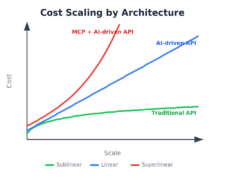
An enterprise builds an AI-powered contract review API that costs $1.58 per document to process: loading the contract, running five extraction passes through an LLM, flagging risks, and generating a summary. The unit economics are reasonable, and the API works well when called by internal applications. Then the team exposes this API via MCP for … continue reading

Over the past year, I’ve watched teams roll out increasingly capable AI systems, tooling, and agents, and then struggle to trust, adopt, or scale them. I’d argue that a lot of today’s AI adoption problem starts with how we are framing the shift. “Human-in-the-loop” (often shortened to HITL) has become one of today’s most overhyped … continue reading